
Since the beginning of summer, discussions on post-war electoral legislation have intensified in the Ukrainian political establishment. In late June, Chairman of the Verkhovna Rada of Ukraine Ruslan Stefanchuk noted that the parliament is developing a bill on organizing elections after the end of the war. Almost simultaneously, in late June and early July, two draft laws amending the Electoral Code were registered in parliament: No. 13419 of June 25, 2025, and No. 13464 of July 10, 2025. The first draft law proposes introducing a plurality electoral system for local elections in communities with up to 50,000 voters, while the second aims to introduce significant changes to the electoral system for parliamentary and local elections, which, conversely, would strengthen party influence.
Despite the existence of expert documents (the White book on the preparation and organization of post-war elections or OPORA's Roadmap for ensuring the organization of post-war elections), Members of Parliament did not begin with urgent security issues or the realization of electoral rights for voter groups vulnerable due to the war (including military personnel and internally displaced persons). Instead, politicians primarily focused on the electoral system.
It is essential to emphasize that these are not temporary measures to mitigate the consequences of the war, but rather permanent changes. If adopted, they will have a fundamental and long-term impact on the political system. The development of such a significant initiative occurred without proper communication and explanations to the public. However, socially important decisions should be developed openly, jointly with civil society, and with adherence to the principle of inclusivity at all stages, from identifying key problems to finding optimal solutions.
Civil Network OPORA analyzed these draft laws. None of them offers a comprehensive approach to addressing key challenges caused by Russia's full-scale aggression against Ukraine, such as multi-million internal and external migration, the destruction of electoral infrastructure, security risks, expected Russian Federation interference in the electoral process due to unregulated campaigning, disinformation in social networks, etc. Instead, the draft laws only propose to modify the systems for parliamentary and local elections.
OPORA has repeatedly emphasized the need to transfer substantive and professional work on electoral reform to the parliament, both in the context of Ukraine's European integration commitments and for a comprehensive solution to the problems of organizing the first post-war elections. The recently registered legislative initiatives can catalyze these processes, even if, due to Russian aggression, parliament does not consider them at this stage. At the same time, the start of preparations for post-war elections does not mean the start of a political race, but rather demonstrates a strategic vision for the country's future development.
To ensure that the discussion on future electoral rules, including electoral systems, is not superficial, we will examine these draft laws in detail, including their main advantages and disadvantages, potential risks, and opportunities. Understanding that determining the electoral system is a political issue that falls within the exclusive competence of parliament, any final decision to change it must be duly justified, based on specific calculations and modeling, and take into account Ukrainian realities and international experience. This approach will help avoid political motives and create a stable, transparent, and fair electoral system that fits post-war realities and helps strengthen democracy.
Key findings
- Draft laws No. 13419 and No. 13464 do not cover post-war challenges. For example, they do not suggest a mechanism for exercising active and passive electoral rights of military servicemen and millions of Ukrainian citizens who legally remain abroad due to Russian military aggression. These draft laws do not regulate the creation of additional electoral infrastructure abroad, do not propose changes to the voting procedure, etc.
- Both draft laws focus on electoral systems, territorial organization, and the distribution of seats, but issues related to the practical organization of the electoral process (the duration and number of voting days, security assessment of the elections, updating voter lists, etc.) remain unresolved.
- The approaches to local elections proposed in the draft laws are contradictory in terms of the threshold for using a proportional electoral system. Bill No. 13419 provides for its application in communities with 50,000 voters or more, while Bill No. 13464 provides for its application in all communities without exception (while not providing for the participation of independent candidates who are self-nominated).
- None of the draft laws contains an analysis of the possible consequences of changing the electoral systems in local elections. For example, draft law No. 13419 does not take into account that in the fully controlled territory of Ukraine, 95.6% of communities have up to 50,000 voters. About half of all voters in Ukraine are registered in such communities. Accordingly, raising the threshold for the application of the majority electoral system on such a scale could lead to the degradation of the party system at the local level. On the other hand, extending the proportional system to all communities (draft law No. 13464) does not comply with the recommendations of the Venice Commission, as it deprives independent candidates of the right to participate in elections. At the same time, the proportional system allows for the replacement of deputies on the party list in the event of the termination of their powers, which increases the functionality of local councils — especially in small frontline communities, where it is impossible to replace majority deputies during the war, and security risks, in particular of renewed Russian aggression, will remain even after the end of the active phase of the war.
- Changes to the parliamentary election system, outlined in the draft law №13464, could lead to increased party control and a reduced influence of voters on the distribution of mandates in the regions. The authors propose that all votes cast for a party's regional list without specifying a particular candidate should be distributed at the level of the respective political party's nationwide list. This means that the distribution of mandates in a region will no longer depend on the total number of votes for the regional list but will be determined exclusively based on the total number of votes cast for individual candidates from that list.
- Draft law №13464 establishes different upper limits for the number of candidates in a regional list, depending on the electoral region. For instance, the list for the city of Kyiv may include up to 28 candidates, while for the Dnipropetrovsk region, it can have up to 32. This approach is explained by the fact that the number of candidates in regional lists is determined proportionally to the number of voters in each electoral region to ensure equal representation in parliament. The proposed innovation is not based on relevant data, as it likely uses current State Voter Register (SVR) figures, according to which, as of July 2025, Ukraine had 32.4 million voters with an electoral address (the largest numbers being in Donetsk Oblast — 2.9 million, Dnipropetrovsk Oblast — 2.3 million, and the city of Kyiv — 2 million; the smallest in Chernivtsi Oblast — 664 thousand, and Sevastopol — 264 thousand). Failing to account for up-to-date data on the actual number of voters could create a significant imbalance in representation. Furthermore, the fact that a party can nominate more candidates in a region does not necessarily mean that this region will receive more seats in parliament. A better solution would be to "link" the number of mandates from a region to the current (updated) number of registered voters. This would ensure stable and proportionate representation for all regions, regardless of voter turnout.
- A significant drawback of the draft law No. 13464 is the abolition of the requirement for a minimum number of candidates on a regional list. This poses risks that parties will manipulate the lower and upper limits, nominating candidates in electoral regions to increase the proportion of “residual” votes, which would then be allocated for the distribution of mandates via the closed nationwide list. This approach undermines the idea of open lists and strengthens the parties' monopoly on political representation.
- Draft law No. 13464 provides for the inclusion of candidates numbered 2-9 on a party's nationwide list into regional lists, but the candidate at number 1 is not included in regional lists. At the same time, the guarantee of 9 mandates from the nationwide list is preserved. Additionally, the central leadership of the party can decide which mandate — nationwide or regional — a candidate from the “top-9” receives if they secured a mandate in both lists. This creates room for manipulation, as it allows popular candidates to “pull” the entire regional list.
- Draft Law No. 13464 proposes to abolish the 25% threshold for advancement in regional lists for parliamentary elections and territorial lists for local elections. Such changes formally align with the political agreements reached between parties during the Jean Monnet Dialogues. However, the competitiveness of candidates for advancement in regional lists may be partially undermined by ‘almost-guaranteed” mandates for the top-ranked candidates. Moreover, in conditions of low political culture, dishonest competition may intensify. Therefore, the optimal solution would be to reduce the advancement threshold to 5% while maintaining the distribution of votes cast for a party list at the regional level. This approach would help balance intra-party competition and prevent abuses.
- The transition to a 30% gender quota in regional (parliamentary elections) and territorial lists (local elections), proposed by the draft law №13464, is explained by a change in the approach to placing candidates in these lists in alphabetical order. However, this might somewhat worsen gender representation compared to the current model, which allows for higher figures — around 40%. Furthermore, the bill does not propose any changes aimed at counteracting "abuses" regarding the non-fulfillment of the gender quota, particularly in cases where a person, after being elected, fails to submit documents for their registration as a deputy or when replacing deputies whose powers have been terminated prematurely. This creates a risk of formal adherence to the quota during list submission and an actual circumvention of the principle of gender-balanced representation.
- Draft law No. 13464 proposes to change the ballot form for parliamentary elections. Specifically, to the right of the full name of each party, two squares are to be placed (an empty one for expressing a vote for the party, and one with a stencil for expressing a vote for a candidate from the party's regional list). The proposed option is better than the current one due to the placement of the field for writing down the candidate's number. This will increase the clarity of the ballot for voters and encourage them to vote not only for a specific party but also for one of its candidates. However, the draft law does not propose changes to the norms that define the grounds for invalidating a ballot, which creates a risk of ambiguous interpretation of the election results.
Review and Assessment of Draft Laws
Disclaimer. Before proceeding to evaluate the aforementioned bills, it is important to note some established positions in international and national practices regarding electoral systems:
- Absence of a single standard: There is no international standard for a universal electoral system that would perfectly suit all states.
- Broad discretion (freedom of choice) of the state: Each country has significant freedom in choosing and constructing its own electoral model. In Ukraine, this falls under the exclusive competence of the parliament (the “political question” doctrine).
- Freedom of choice is not absolute: Any system is permissible only if it guarantees the fundamental principles of electoral law.
Draft Law No. 13464 (registered on July 7, 2025)
This draft law proposes significant changes to the systems of parliamentary and local elections.
Parliamentary Elections
Forming of Regional Lists:
- Regional lists are formed from candidates who are included in the party's nationwide list, except for the first candidate. The current version of the Electoral Code stipulates that candidates under the first 9 numbers of the nationwide list are not included in regional lists. At the same time, the norm regarding 9 guaranteed mandates at the nationwide level will remain in force. The only change is that candidates under numbers 2-9 in the nationwide list will also be included in regional lists.
- In a regional list, the party determines only the first candidate. The remaining candidate names are placed in alphabetical order. Currently, the order of candidates in regional lists is determined at the party's congress (assembly, conference).
- A different upper limit for the number of candidates in a regional list is established depending on the electoral region. At the same time, the requirement for a minimum number is abolished. For example, the list for Kyiv can have a maximum of 28 candidates, for Dnipropetrovsk Oblast — 32, and for the combined Southern Electoral Region №16, consisting of Kherson Oblast, the Autonomous Republic of Crimea, and the city of Sevastopol — 36. In the explanatory note, the authors of the bill explain this approach by stating that the number of candidates in regional lists is determined proportionally to the number of voters in each electoral region. The current version of the Electoral Code stipulates that a party's regional electoral list must consist of no less than 5 and no more than 18 candidates.
OPORA’s Assessment
The proposed innovation — establishing a different fixed number of candidates for elections to the Verkhovna Rada of Ukraine depending on the electoral region — is not based on relevant data. This is likely because it uses current State Voter Register (SVR) figures, according to which, as of July 2025, Ukraine had 32.4 million voters with an electoral address (the largest numbers being in Donetsk Oblast — 2.9 million, Dnipropetrovsk Oblast — 2.3 million, and the city of Kyiv — 2 million; the smallest in Chernivtsi Oblast — 664 thousand, and Sevastopol — 264 thousand). However, given the large-scale migration processes and temporary occupation, these data do not reflect the actual state of affairs.

For example, when calculating the number of candidates in the Southern Electoral District (№16), voters from temporarily occupied territories — Sevastopol, Nova Kakhovka, Henichesk, etc. — are taken into account. Similarly, the Donetsk electoral region (№5) includes voters from Bakhmut, Avdiivka, Vuhledar, and other occupied cities. This distorts the real electoral picture and calls into question the validity of such an approach.
According to OPORA's calculations, excluding Crimea and Sevastopol, the territory of 157 communities in Ukraine is either fully or more than two-thirds occupied. This amounts to approximately 4,200 polling stations, encompassing 5 million voters. In the territory of Crimea and the city of Sevastopol, there are an additional 1,430 polling stations (1.7 million voters) under occupation. The territories of 19 communities (200,000 voters) are partially occupied.
Accounting for the number of voters in a particular region could align with best practices if the number of mandates distributed in the regions depended on the number of registered voters. This would ensure stable proportional representation of all regions in parliament, regardless of fluctuating turnout figures. Due to security threats, especially in the territories that have suffered significant destruction and/or are located near the demarcation line, turnout could be very low.
However, it should be considered that a fixed number of mandates in the regions can also lead to negative consequences, such as inter-regional polarization, where representatives of more populated regions will be dissatisfied that less populated regions receive disproportionately high representation in parliament. This would also necessitate a transition to a regional electoral quota, which, given significant differences in the "number of votes required to obtain one mandate," would only intensify accusations of violating the principle of equal elections.
In the event of a transition to a fixed number of candidates and mandates in electoral regions, it is important for legislation to include a formula for calculating the number of mandates that would account for the consequences of migration processes. Such a formula should be based on up-to-date data regarding the number of voters in the region at least one month before the start of the electoral process.
At the same time, it is first and foremost important to adapt the parliamentary electoral system to account for the expansion of occupied territories.
Another significant drawback of the draft law No. 13464 is the abolition of the requirement for a minimum number of candidates on a regional list. This creates the risk that parties will manipulate the lower and upper limits when nominating candidates in electoral regions, in order to increase the share of “residual” votes, which would then be directed towards the distribution of mandates via the closed nationwide list. This approach undermines the idea of open lists and strengthens the parties' monopoly on political representation.
Gender Quotas:
- The "zipper quota" approach is maintained for the nationwide list: each group of five candidates must include at least two candidates of each gender.
- In regional lists, considering the alphabetical placement of candidates and the abandonment of party-determined order, it is proposed to change the "zipper" approach and establish a requirement for the representation of individuals of one gender at a level of no less than 30%.
OPORA’s Assessment
Given the alphabetical placement of candidates in a regional list, the transition to a percentage-based gender quota is quite logical. However, its implementation in absolute figures (30%) will have worse prospects than the current model, which allows for gender representation at around 40%, as clearly illustrated in the 2020 local elections.
Despite the modification of the approach to the gender quota in the regional list, the draft law does not propose any changes aimed at counteracting the non-fulfillment of the gender quota, particularly in cases where a person, after being elected, fails to submit documents for their registration as a Member of Parliament or when replacing Members of Parliament whose powers have been prematurely terminated. This creates a risk of formal adherence to the quota during list submission and an actual circumvention of the principle of gender-balanced representation.
Changes in the Ballot Paper:
- The ballot paper will contain the party's name, the last names of the first 9 candidates from the nationwide list (without numbering), and a complete list of candidates from the relevant regional list with their serial numbers.
- Two fields are provided for voting: one for marking the party, and the other (with a stencil) for writing in the number of the desired candidate from that same party's regional list.
OPORA’s Assessment:
The proposed ballot paper option is better than the current one due to the placement of the field for writing down the candidate's number next to the field for marking the party. Placing such a field at the bottom of the ballot does not promote personalized voting for specific candidates. An inconvenient location for the specific candidate's number field can lead to voters only casting a vote for the party and overlooking or avoiding supporting its representative.
During OPORA's study, "How voters perceive different types of ballot papers to improve the election process" (2021), not all focus group respondents noticed the field for voting for a separate candidate at the very end of the ballot paper. Overall, respondents rated this method of entering a candidate's number as the least convenient way to arrange the layout elements. The study also recommended avoiding postal code-like markings for entering the numbers of candidates from political parties, as most respondents do not remember the correct way to write numbers using the coding accepted in postal services. Even if such writing is not mandatory, it creates unnecessary doubts for respondents. In cases where abandoning such writing is impossible, it would be advisable to at least print the list of candidates with exactly those numbers so that voters can simply copy the desired one. On the other hand, digital markings in the filling area improve the understanding that a number should be entered into that specific field, but such markings should still follow some generally accepted style.
While envisioning changes in the ballot paper form—specifically, placing two squares to the right of each party's full name (an empty one for expressing a vote for the party, and one with a stencil for expressing a vote for a candidate from the party's corresponding regional list)—the bill does not amend the provisions that define the conditions for invalidating a ballot. This creates a risk of ambiguous interpretation of the election results. According to the current version of the Electoral Code, a ballot is considered invalid if no mark is placed next to the full name of a political party. In this regard, the question arises: will a ballot be considered valid if the voter indicated a candidate's number but did not mark the party?
Voting Mechanism and Mandate Distribution:
- If a voter marks a party but does not write down a candidate's number (or writes down a non-existent one), their vote is counted in support of the entire regional party list. This provision is consistent with the current version of the Electoral Code.
- The distribution of mandates in a region does not depend on the total number of votes for that list, but on the cumulative number of votes cast for individual candidates from that list. All votes for a party's regional list without specifying a candidate's number will be distributed at the level of the respective party's nationwide list. The current procedure involves including these votes in the “basket” for the regional list when determining the number of mandates a party receives in the electoral region from that list.
- Candidates on regional lists who have received a number of votes equal to or greater than the electoral quota are guaranteed to receive a mandate first, without participation in subsequent ranking.
- The candidate at number 1 on the regional list, who has not received votes equal to or greater than the electoral quota, is placed first among those participating in further ranking. Other candidates are ranked in decreasing order of voter votes. If the number of votes is equal, the candidate determined by the central governing body of the party through a draw, conducted in the manner established by the Central Election Commission, takes the higher place. Thus, the 25% threshold of the electoral quota for changing the order of candidates in the regional list is abolished.
- If a candidate who is entitled to a guaranteed mandate in the nationwide district (a candidate from the top nine) also received a mandate in the region, the electoral list under which they will be declared elected is determined by the decision of the party's central governing body, with subsequent notification to the Central Election Commission.
OPORA’s Assessment:
Despite the criticism of the so-called "guaranteed mandates," which was one of the reasons for the President to veto the Electoral Code in 2019, the number of such mandates will increase even further under the proposed model. In addition to the 9 candidates on the nationwide list, the first candidate in each regional list will also have a privileged right to a mandate—regardless of voter support. This approach significantly weakens the idea of open lists, as voters will effectively have no influence on the distribution of at least 34 mandates, shifting the emphasis towards the “closedness” of the system. Furthermore, it creates conditions for the leadership-type regional lists, where the main emphasis will be placed on the first candidate.
The abolition of the 25% threshold of the electoral quota for advancement in regional lists, on the one hand, corresponds to the political agreements reached during the IX Jean Monnet Dialogue on November 10-12, 2023 (p. 5), and appears to ensure the competitiveness of candidates within a single party list. On the other hand, coupled with other proposed innovations, such a decision can lead to negative consequences. Ukraine has one of the strictest models for advancement on lists among European countries. In many states, achieving 5% of votes or a higher result compared to other candidates on the list is often sufficient. At the same time, the latter approach can provoke excessive intra-party competition, which harms the campaign. Therefore, establishing such a “legitimacy barrier” is considered more justified, especially in conditions of low political culture, party weakness, and high risks of dishonest competition.
Granting the central governing body of a party the ability to determine the electoral list by which a candidate, who is entitled to a guaranteed mandate in the nationwide constituency (a candidate from the top nine) and at the same time received a mandate from a regional list, will be declared elected, creates a risk of manipulating voter expectations. In its Decision of the Grand Chamber of the Constitutional Court of Ukraine of December 21, 2017, №3-р/2017 (case on the exclusion of candidates from the electoral list), it was emphasized that the state has an obligation to ensure the free expression of citizens' will and respect for its results through proper regulation of the electoral process, adherence to democratic procedures, and effective control that prevents abuse and manipulation (para. 3, sub-para. 2.4, point 2 of the reasoning part). Recently, in its decision of July 10, 2025, the ECHR in the case of Tomenko v. Ukraine, guided by the position of the Venice Commission and its previous practice (in particular, the Paunović and Milivojević case), emphasized that deputies hold a mandate from the people, not from their parties, which are merely institutional intermediaries, and it is not a party that controls the social contract between voters and parliament.
Therefore, the involvement of candidates with guaranteed mandates in regional campaigns lies in the realm of political calculations and is evidence of the formal openness of the electoral model, which in practice strives to retain the characteristics of a closed and controlled system.
Furthermore, the bill does not contain a mechanism for replacing a guaranteed mandate if the party decides that such a candidate receives a mandate from the regional list. Such regulation will incentivize parties to choose in favor of the nationwide list, and thus, “close” the list.
Local Elections
Unified Electoral System for All Councils:
- Elections for deputies of all local councils (village, settlement, city, district, regional) are conducted under a proportional system with open party lists.
- The majority system for communities with up to 10,000 voters is abolished. This means that self-nomination for local council deputies becomes impossible—candidates can only be nominated by local party organizations.
OPORA’s Assessment:
The proposed mechanism will not comply with international obligations, particularly paragraph 7.5 of the OSCE Copenhagen Document of 1990. According to this document, OSCE participating states undertook to "respect the right of citizens to seek political or public office, individually or as representatives of political parties or organizations, without discrimination." This was noted by ODIHR mission representatives in their final report on the observation of the local elections on October 25, 2020 (p. 10). This will also contradict the requirements of the Functioning of Democratic Institutions Roadmap, the implementation of which should facilitate Ukraine's accession to the EU.
In our country, the practice of self-nomination in local elections is widespread. In 2020, in communities with up to 10,000 voters, 32% of all candidates for local councils ran as self-nominated candidates. Among all elected city, settlement, and village heads, almost 47% of the winners were self-nominated, and among deputies of territorial communities with up to 10,000 voters, 39.2% of self-nominated candidates won mandates. This indicates that in Ukraine, the practice of voting for independent candidates remains the most popular within the framework of electoral systems that provide such an opportunity.
Furthermore, the possibility of self-nomination of candidates (in one form or another) in local elections is provided for in most European countries within proportional systems. This possibility is realized through lists of independent candidates. The introduction of such a model in Ukraine would allow for the filling of vacant deputy mandates without by-elections, which is especially important in wartime conditions. This would help preserve the functionality of local self-government bodies and prevent excessive centralization of power through military administrations in case it is impossible to hold interim elections.
Additionally, in the White Book on the Preparation and Organization of Post-War Elections (prepared by experts from OPORA, Centre for Policy and Lawl Reform, and IFES), the authors draw attention to the following negative aspects (pp. 38-39):
- The impossibility of self-nomination in elections leads to parties nominating candidates who are not their members and do not share the party's ideology/program;
- A potential candidate who could not “agree” with any party on the terms of their nomination in elections is incentivized to create their own party to nominate themselves in elections, leading to the emergence of “technical,” “town hall,” and “personal” parties, whose main ideology is populism;
- The prohibition of self-nomination in elections does not achieve the goal set for its implementation — it does not stimulate factional discipline, does not prevent political fragmentation of elected bodies, and does not ensure the institutionalization of parties.
Forming the Lists in Local Elections
- Analogous to national elections, candidates in territorial electoral lists are placed in alphabetical order, whereas the party determines the order of candidates in the single electoral list.
- Requirements for the number of candidates in a party's territorial list (from 5 to 12 candidates) remain unchanged.
OPORA’s Assessment:
The alphabetical placement of candidates in the territorial list is a consequence of abolishing the 25% threshold of the electoral quota for advancement on the list. With such a threshold, parties had a reason to arrange candidates by order, as it was more difficult for voters to change the order of mandate acquisition. Now, a candidate only needs a minimal number of votes to move up the list, which negates the importance of the first candidate, whose mandate is no longer guaranteed. At the same time, the possibility of registering a minimum number of candidates on the regional list will contribute to the closed nature of the system, reduce competition, and increase the number of residual votes that will be reallocated to the single list.
Gender Quotas
- In the single list, each group of five candidates must include at least two candidates of each gender. This provision is consistent with the current version of the law.
- In territorial lists, the representation of one gender cannot be less than 30%.
OPORA’s Assessment:
The initiators of the draft law propose a transition to a “percentage-based” gender quota, analogous to what is suggested for parliamentary elections, which is entirely logical given the alphabetical placement of candidates in the regional list. However, as previously noted, introducing a gender requirement in absolute figures (30%) will have worse prospects than the current model, which allows for gender representation at around 40%. This was vividly illustrated by the 2020 local elections—the effect of gender quota was impressive. Among all candidates, 44.7% were women, and about 37% of women were elected to various levels of councils in Ukraine.
As with parliamentary elections, despite the modification of the approach to the gender quota in the territorial lists, the draft law in no way proposes a solution to the problems observed with adherence to the gender quota in the 2020 local elections. For instance, despite the legally established obligation to comply with the gender quota, some electoral process actors tried to ignore it during the nomination and registration of candidates or circumvent it by encouraging women to withdraw their candidacy after the electoral list was registered by the respective election commission, or to give up their representative mandate, which ultimately contributed to the election of more men. Furthermore, there was widespread judicial practice where non-compliance with the gender quota was interpreted as a technical error and allowed to be corrected.
In this regard, OPORA, in its Final Report on the results of observation of the 2020 local elections, emphasized that the next stage of electoral reform should include the improvement of procedures for ensuring the gender quota in the electoral lists of local political party organizations at the stage of their registration, the cancellation of registration of individual candidates from such lists, and the preservation of gender balance in elected bodies of power during the distribution of mandates. This problem was also highlighted by the OSCE Office for Democratic Institutions and Human Rights (ODIHR) in its monitoring mission report on the observation of the 2020 local elections. It recommended that Ukraine consider compliance with the gender quota for candidate lists at all stages of the electoral process, especially during nomination and registration.
Mandates Distribution
- During the distribution of mandates from territorial lists, candidates for deputies are ranked in descending order of the number of votes each has received. This means that the 25% threshold of the electoral quota for a candidate's advancement in a party's territorial list is completely abolished.
- In the event of an equal number of votes, the candidate is determined by the party's governing body through a lottery, in the manner established by the Central Election Commission.
- The guaranteed mandate for the first candidate on the single electoral list is abolished, which also simplifies the calculation of the electoral quota.
OPORA’s Assessment:
As with parliamentary elections, the abolition of the 25% threshold of the electoral quota for advancement in territorial lists can lead to excessive intra-party competition and create additional incentives for voter bribery. Therefore, OPORA consistently supports the idea of lowering the electoral quota to 5%, rather than abolishing it entirely.
A positive step is the abandonment of automatically granting a mandate to the first candidate on the single party list. This eliminates a widespread practice where well-known individuals (MPs, top officials) are nominated as first numbers solely to boost party ratings, without a genuine intention to participate in the work of local councils. This enhances voter influence on mandate distribution and reduces the formality of leadership positions in party lists.
Draft Law No, 13419 (registered on June 26, 2025)
The draft law envisages raising the threshold for applying the majoritarian system.
- Compared to the previous one, the draft law No. 13419 of June 25, 2025, provides for changes only in the part concerning elections to village, settlement, and city councils, aimed at raising the threshold for applying the majoritarian electoral system in multi-mandate electoral districts in communities with up to 50,000 voters. Currently, the Electoral Code provides for the application of this system in communities with up to 10,000 voters.
OPORA’s Assessment:
In 2020, Civil Network OPORA already criticized the excessively low threshold for applying the proportional electoral system in communities with 10,000 or more voters. We emphasized the significant risks of such "partification," which substantially limits citizens' ability to self-nominate in local elections, could lead to undesirable polarization of Ukrainian regions based on election results, and also intensifies the politicization of local self-government bodies through party control over their nominees via recalling local council deputies. However, it is worth noting that after the introduction of martial law due to the full-scale Russian invasion, such "partification" contributes to ensuring the functionality of many local councils by replacing their deputies from the electoral list.
At the same time, raising the threshold for applying the majority system, although it has a number of significant advantages, such as strengthening ties with voters, must be based on specific calculations and modeling of its impact on a significant portion of communities and, as a result, on the development of municipal democracy.
So, as of July 2025, 1470 communities have been formed in Ukraine (excluding Crimea and the city of Sevastopol). According to the State Voter Register portal, information on 1773 communities can be obtained. However, 302 of them are located in Crimea, and one more is the city of Sevastopol. Also, according to OPORA's calculations, the territory of 157 communities is either fully or more than two-thirds occupied. The territory of another 19 communities is partially occupied.
.png)
Among the communities fully under Ukraine's control, the largest category is those with up to 10,000 voters. There are 735 such communities (56.8%). There are 329 (25.4%) communities with 10-20 thousand voters, 20-30 thousand — 113 (8.7%), 30-40 thousand — 48 (3.7%), 40-50 thousand — 13 (1%), 50-100 thousand — 30 (2.3%), 100-200 thousand — 10 (0.8%), 200-500 thousand — 10 (0.8%), and over 500 thousand — 6 (0.5%).
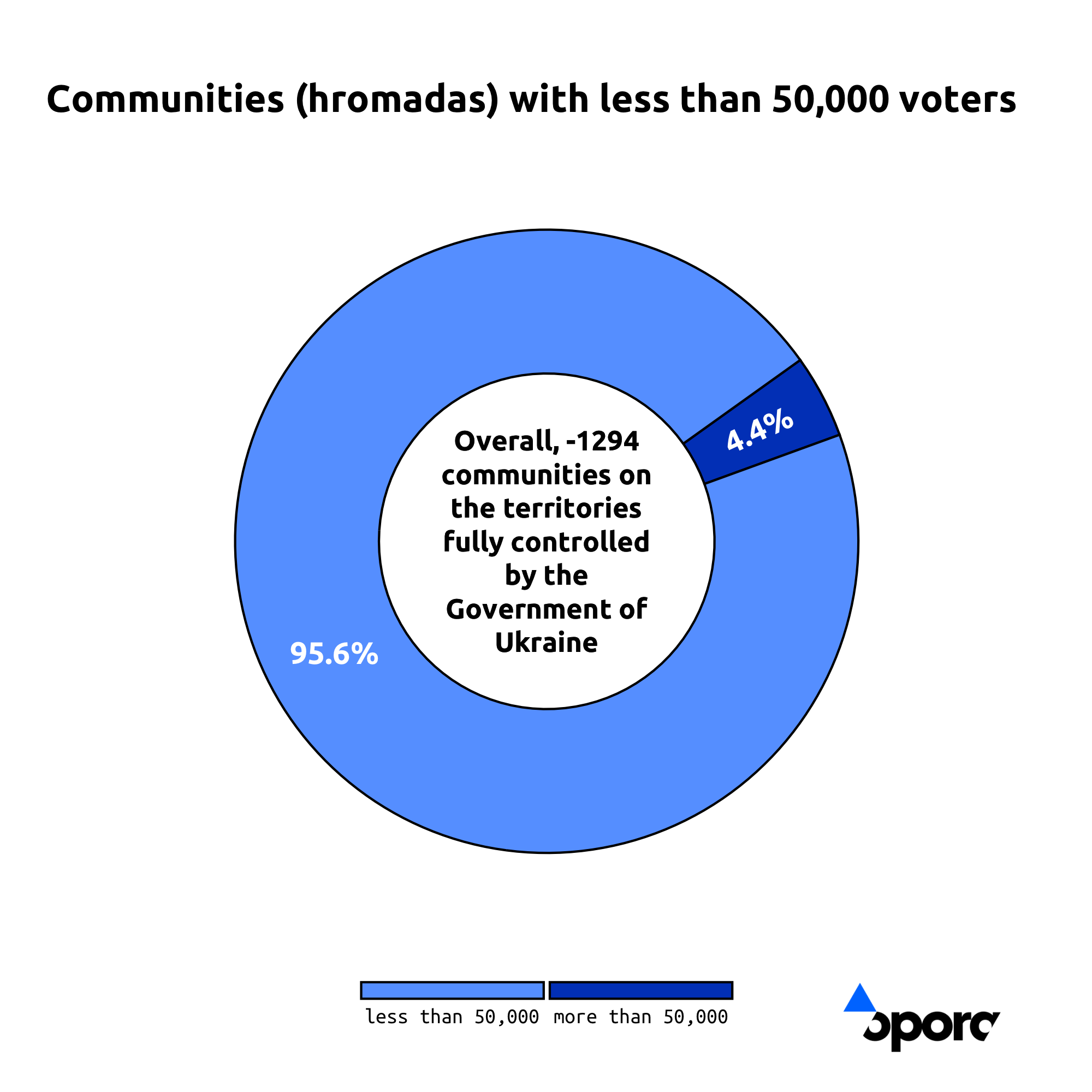
Currently, the share of communities with fewer than 50,000 voters is 95.6%. This accounts for 1238 communities where 13.8 million voters (54%) have registered electoral addresses. In communities with over 50,000 voters, 11.75 million voters (46%) are registered. Given this, the widespread application of the majoritarian electoral system will effectively cover almost all communities in the country and will inevitably be accompanied by its classic disadvantages—vulnerability to bribery; weak party competition; and the risk of mandates remaining vacant for prolonged periods in cases of early termination of deputies' powers when by-elections are impossible. Such an approach could significantly affect the functionality of local councils and weaken the development of the party system at the local level—if not halt it entirely. At the same time, the majoritarian system remains clear to voters, contributes to strengthening the connection between citizens and deputies, and increases the accountability of elected representatives.
Ultimately, OPORA's main concern is that the authors of the bill do not justify the choice of community size and do not consider the long-term effects of the proposed changes. Any innovations must be based on current data, provide for an assessment of consequences, and correspond to a legitimate goal and public interest. If different electoral systems are applied for each local election, the effect of their application will be primarily technical and, likely, negative.
General Conclusion
Beginning work on legislation for post-war elections is an important and necessary step. For this work to be successful, it is crucial to immediately define clear priorities, which undoubtedly include guaranteeing the rights of all voters and the security of the electoral process. Instead, the registered draft laws primarily shift focus to the mechanics of electoral systems, leaving aside comprehensive solutions for millions of military personnel and displaced persons, as well as security issues at polling stations.
A discussion about the optimal electoral model is, of course, necessary, but it must be derived from the main goal, which is the protection of citizens’ electoral rights. It is important to ensure that any changes do not create unintended risks, such as an imbalance of representation or increased party control as opposed to the will of citizens. Creating effective and sustainable legislation is possible only through an inclusive dialogue that involves open cooperation in parliament with the participation of civil society, experts, and representatives of groups whose rights are most vulnerable. Such an approach, based on data and trust, will allow for the development of a system that truly strengthens Ukrainian democracy.